Data & Research
How to build media lists that get more coverage
Analysis of 5,478 pitches reveals silent journalists produce coverage at half the rate of fresh contacts, costing brands 88 pieces of coverage across their.
Tom Lawrence
September 2026 · 4 min read
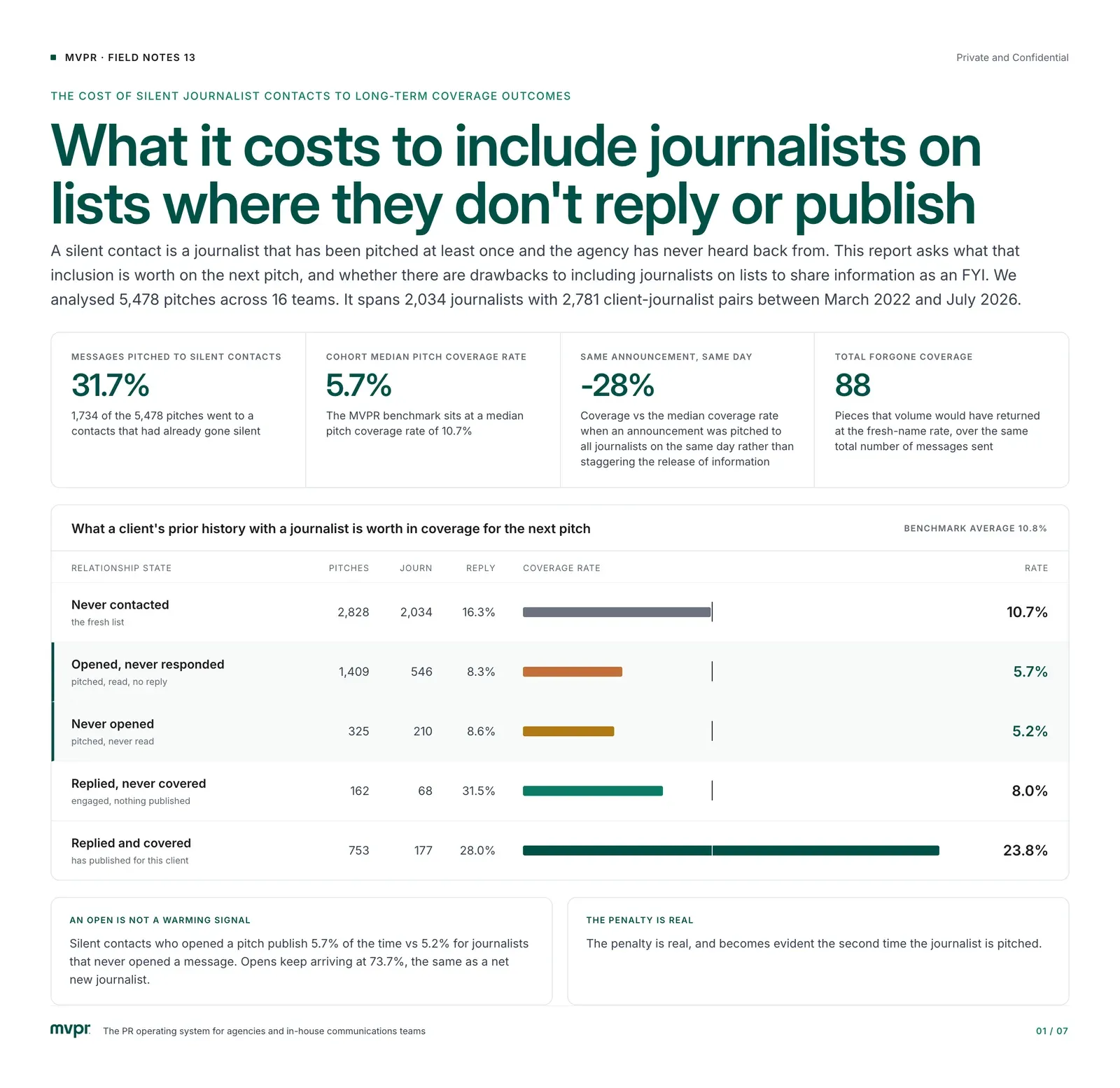
Nearly a third of pitches go to journalists who have already stopped responding - and those pitches produce coverage at half the rate of net new journalist contacts
The data below comes from MVPR’s analysis of 5,478 pitches sent across 16 teams, covering 2,034 journalists and 2,781 client-journalist pairs between March 2022 and July 2026. All figures are from MVPR via its MCP.
1,734 of the 5,478 pitches, 31.7% of all pitches sent, went to journalist contacts that had previously never engaged in any way with that brand. Against an MVPR benchmark median coverage rate of 10.7%, the cohort of silent journalists produced a median coverage rate of 5.7%. Across the same total number of pitches sent, that gap costs 88 pieces of coverage based on the total coverage achieved against that amount of pitches - leaving coverage on the table.
Forecasted Coverage rate by journalist relationship state
The table below shows coverage rate and reply rate for each relationship state, ranked by coverage rate. Sent shows the number of pitches. Journalists shows the number of unique journalist recipients in each state.
| Relationship state | Pitches sent | Journalists | Reply rate | Forecasted Coverage rate |
|---|---|---|---|---|
| Has published for this client | 753 | 177 | 28.0% | 23.8% |
| Never contacted (fresh list) | 2,828 | 2,034 | 16.3% | 10.7% |
| Replied, never covered | 162 | 68 | 31.5% | 8.0% |
| Opened, never responded | 1,409 | 546 | 8.3% | 5.7% |
| Never opened | 325 | 210 | 8.6% | 5.2% |
The benchmark average coverage rate across all states is 10.8%.
A silent journalist produces half the coverage rate of fresh contacts
Journalists in the two silent states, those who opened a pitch but never replied and those who never opened a message at all, produced coverage rates of 5.7% and 5.2% respectively. Fresh contacts, journalists never previously pitched by this client, produced a coverage rate of 10.7% from 2,828 pitches to 2,034 journalists.
The gap between fresh contacts and the opened-but-silent group is 5.0 percentage points. The gap between fresh contacts and the never-opened group is 5.5 percentage points. Both silent groups account for 1,734 of the 5,478 pitches sent, 31.7% of all pitches, and the two groups together cover 756 journalists.
Pitching journalists who have already gone silent rather than fresh contacts is associated with a coverage rate that is roughly half the fresh-contact rate, across 1,734 pitches and 756 journalists.
Opens still arrive from silent journalists - but coverage does not follow
One finding cuts against the instinct to keep silent journalists on the list because they are still opening pitches. Silent journalists who had previously opened a pitch continued to open new pitches at a 73.7% open rate, the same open rate as a net new journalist contact. Despite that open rate, their coverage rate was 5.7%, against 10.7% for fresh contacts.
The open rate from the silent cohort of 546 journalists is not a reliable signal that coverage will follow. The penalty becomes evident the second time a journalist in this state is pitched rather than the first.
The journalists who have replied but never published are the exception
The one silent-adjacent group that outperforms fresh contacts is journalists who replied to a pitch but never produced a piece of coverage. From 162 pitches to 68 journalists, this group produced a coverage rate of 8.0% and a reply rate of 31.5%. That reply rate is the highest of any group in the table, including journalists who have previously published for the client.
This group is small: 68 journalists and 162 pitches. The sample is too small to draw a firm conclusion, and we keep monitoring it. But the direction is consistent with the idea that a reply signals intent that a future pitch may convert, even where previous pitches did not produce a piece of coverage.
The journalists who have published before produce coverage at more than twice the fresh-contact rate
Journalists who have previously published for the client produced a coverage rate of 23.8% from 753 pitches to 177 journalists. That is 13.1 percentage points above the fresh-contact rate of 10.7% and more than four times the rate of either silent group.
Their reply rate was 28.0%, the second highest of any group in the table.
88 pieces of coverage were forgone by pitching silent rather than fresh contacts
Across the same total number of pitches sent, replacing the 1,734 pitches to silent contacts with pitches to fresh contacts at the fresh-contact rate of 10.7% would have returned coverage at a rate consistent with the fresh-contact benchmark. The data puts the volume forgone at 88 pieces of coverage.
Pitching to journalists who had already gone silent rather than fresh contacts is also associated with a coverage rate that is 28% below the median coverage rate recorded when an announcement was pitched to all journalists on the same day rather than staggered.
What brands can do to create the best media lists:
Audit the silent contacts on each client list before the next pitch goes out. The data covers 16 teams and 2,781 client-journalist pairs. The cost of carrying silent contacts is not hypothetical: 1,734 pitches and 88 pieces of coverage set the scale.
Three actions follow from the data.
- For the next 3 releases, move the ‘opened, never responded’ cohort of 546 journalists off the default send list and replace them with fresh contacts, then compare the coverage rate and total coverage outcomes of the two approaches. Use the list management and journalist relationship state filters in the MVPR announcement workflow to identify and separate this group without manual tagging.
- Keep the ‘replied, never covered’ group of 68 journalists on the list. Their reply rate of 31.5% from 162 pitches is the highest of any group, and their coverage rate of 8.0% sits above the silent-group rates. The sample is small and we keep monitoring it.
- Prioritise the 177 journalists who have previously published for the client on every send. Their coverage rate of 23.8% from 753 pitches is more than double the fresh-contact rate. Use the relationship history view in the MVPR platform to surface this group at the point of list building rather than after the pitch has been sent.
Related posts
Data & Research
How long should I wait before pitching a new journalist?
MVPR data on pitching timing: how long to wait, when to follow up, and what journalist response patterns tell you about the right moment to try again.
Data & Research
How to Build Media Lists That Guarantee Coverage
Response rate is the only media list metric that matters. MVPR data shows exactly what separates lists that earn coverage from lists that don’t.
Data & Research
MVPR Data: Remove Silent Journalists from Press Lists
Analysis of 5,478 pitches reveals silent journalists convert at 5.7% versus 10.7% benchmark. Removing unresponsive contacts improves coverage rates and list.