Data & Research
MVPR Data: Remove Silent Journalists from Press Lists
Analysis of 5,478 pitches reveals silent journalists convert at 5.7% versus 10.7% benchmark. Removing unresponsive contacts improves coverage rates and list.
Tom Lawrence
September 2026 · 4 min read
If you run a PR team or head up comms somewhere, this one’s worth a read. We pulled four years of pitch data - 5,478 pitches, 16 teams, 2,034 journalists - and found something that quietly costs agencies a lot of coverage every year. It’s the habit of re-pitching journalists who’ve never responding, thinking “I’ll just include them on this one, you never know - what’s the harm(?)”.
We call this pitching silent journalists. And the numbers aren’t kind.
What is a silent journalist, exactly?
A silent journalist is any journalist your team has pitched at least once and never heard back from. No reply, no coverage, no acknowledgement. They exist on your list, they keep getting pitched, and most of the time nobody stops to ask whether that’s actually working.
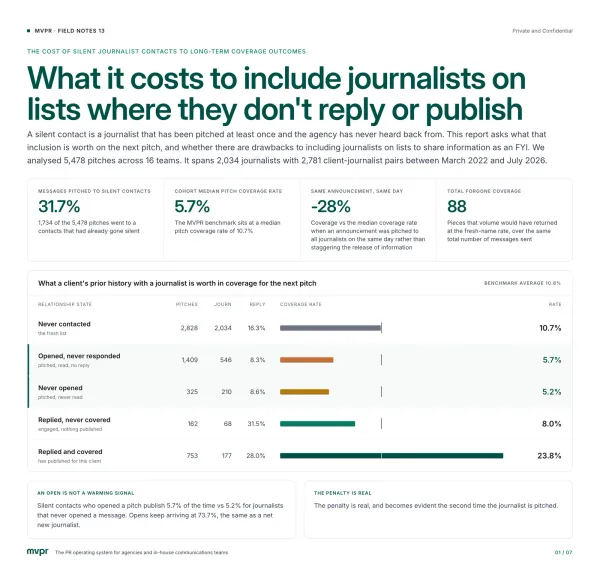
Across our dataset, 31.7% of all pitches went to silent journalists. That’s 1,734 pitches out of 5,478 - nearly a third of everything your team sends, landing with people who’ve never once responded to you.
The coverage gap is bigger than you’d think
Here’s the headline figure. The median coverage rate for silent journalists is 5.7%. The MVPR benchmark median is 10.7%. That’s not a rounding error - it’s a near-halving of your expected return on every pitch you send into that group.
If those 1,734 pitches had converted at the benchmark rate instead, the data suggests you’d have earned roughly 88 additional pieces of coverage. That’s real editorial, from pitches you were already sending, to a list you were already managing.
Breaking down the relationship states
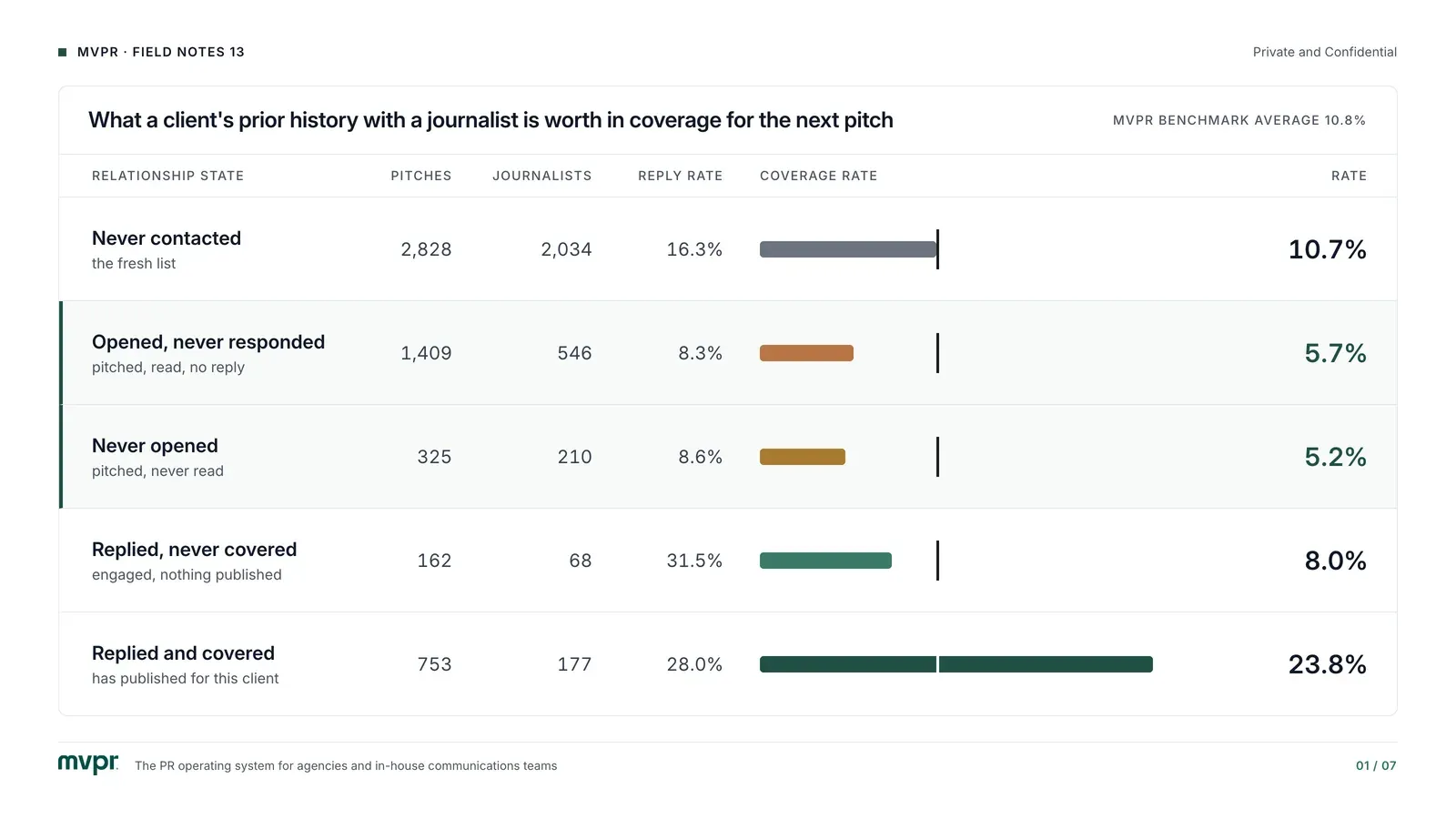
Not all silence is the same, and that’s where it gets interesting. Here’s how different journalist relationship states performed across the dataset.
| Relationship | Pitches | Reply rate | Coverage rate |
|---|---|---|---|
| Never contacted | 2,828 | 16.3% | 10.7% |
| Opened, never responded | 1,409 | 8.3% | 5.7% |
| Never opened | 325 | 8.6% | 5.2% |
| Replied, never covered | 162 | 31.5% | 8.0% |
| Replied and covered | 753 | 28.0% | 23.8% |
A few things jump out here. Fresh contacts - journalists you’ve never pitched before - deliver a 10.7% coverage rate and a 16.3% reply rate. That’s your benchmark. Journalists who’ve opened a pitch but never replied drop to 5.7% coverage and 8.3% replies. And journalists who’ve never even opened one sit at 5.2% and 8.6% - barely different from each other, but both well below where you want to be.
The two relationship states worth paying attention to on the upside are the ones involving prior replies. Journalists who’ve replied but never produced coverage still convert at 8.0% - noticeably above silent journalists. And journalists who’ve actually covered a client before? They hit 23.8% coverage and 28.0% replies. More than double the benchmark.
The open rate illusion
Here’s a detail that catches a lot of teams off guard. Silent journalists who’ve opened a pitch maintain a 73.7% open rate - identical to journalists being contacted for the first time. So if you’re looking at open rates to decide whether a contact is engaged, silent journalists will look just fine.
The tell is the reply rate. It drops from 16.3% for fresh contacts down to 8.3% for journalists who’ve opened and stayed quiet. They’re reading the pitch. They’re just not acting on it. Open rates alone won’t surface that distinction, and if that’s your primary signal for list health, you’re probably overestimating how warm those contacts actually are.
One timing habit that makes things worse
Beyond the relationship state issue, there’s a compounding factor in how pitches go out. Sending the same announcement to all journalists on the same day - rather than in stages - produces a coverage rate that’s 28% below the median. Blanket same-day sends to a list that already includes a chunk of silent journalists compounds the problem twice over.
What this means for how you manage your list
The practical implication here isn’t that you should delete every journalist who hasn’t replied. It’s that silent status should be a deliberate list-management signal, not something that just gets ignored.
A few things worth thinking about if you want to close the gap.
- Track relationship state explicitly — fresh, silent-opened, silent-never-opened, replied, covered - and let that inform pitch priority.
- Don’t treat open rates as a proxy for engagement. They hold up even when coverage rates collapse.
- Weight your pitching effort toward journalists who’ve replied before, covered before, or haven’t been contacted at all. The data is pretty clear on where the returns are.
- If you’re sending blanket same-day pitches to large lists, consider whether staging by relationship state would help you get more out of the same number of pitches.
- Revisit silent contacts intentionally rather than passively - a different angle, a different story type, or a different team member reaching out can sometimes shift the dynamic.
The takeaway
Nearly a third of pitches in this dataset went to journalists who’d never once responded. Those pitches converted at roughly half the benchmark rate. That gap added up to around 88 pieces of coverage left on the table, from pitches the teams were already sending.
The fix isn’t a bigger list or more pitches. It’s knowing which part of your list is actually working and putting more of your effort there. Silent journalists aren’t a write-off, but they need a different kind of attention - not just another pitch on the same day as everyone else. Take the time and effort to personalise something for them.
Related posts
Data & Research
How to build media lists that get more coverage
Analysis of 5,478 pitches reveals silent journalists produce coverage at half the rate of fresh contacts, costing brands 88 pieces of coverage across their.
Data & Research
How long should I wait before pitching a new journalist?
MVPR data on pitching timing: how long to wait, when to follow up, and what journalist response patterns tell you about the right moment to try again.
Data & Research
How to Build Media Lists That Guarantee Coverage
Response rate is the only media list metric that matters. MVPR data shows exactly what separates lists that earn coverage from lists that don’t.